






Kenta Sugiura1, Ichiro Kawasaki1, Hidetaka Kosako2, Ken Sato1* (1. Lab. of Molecular Traffic, Institute for Molecular and Cellular Regulation, Gunma Univertisy; 2. Institute of Advanced Medical Sciences, Tokushima University)
About
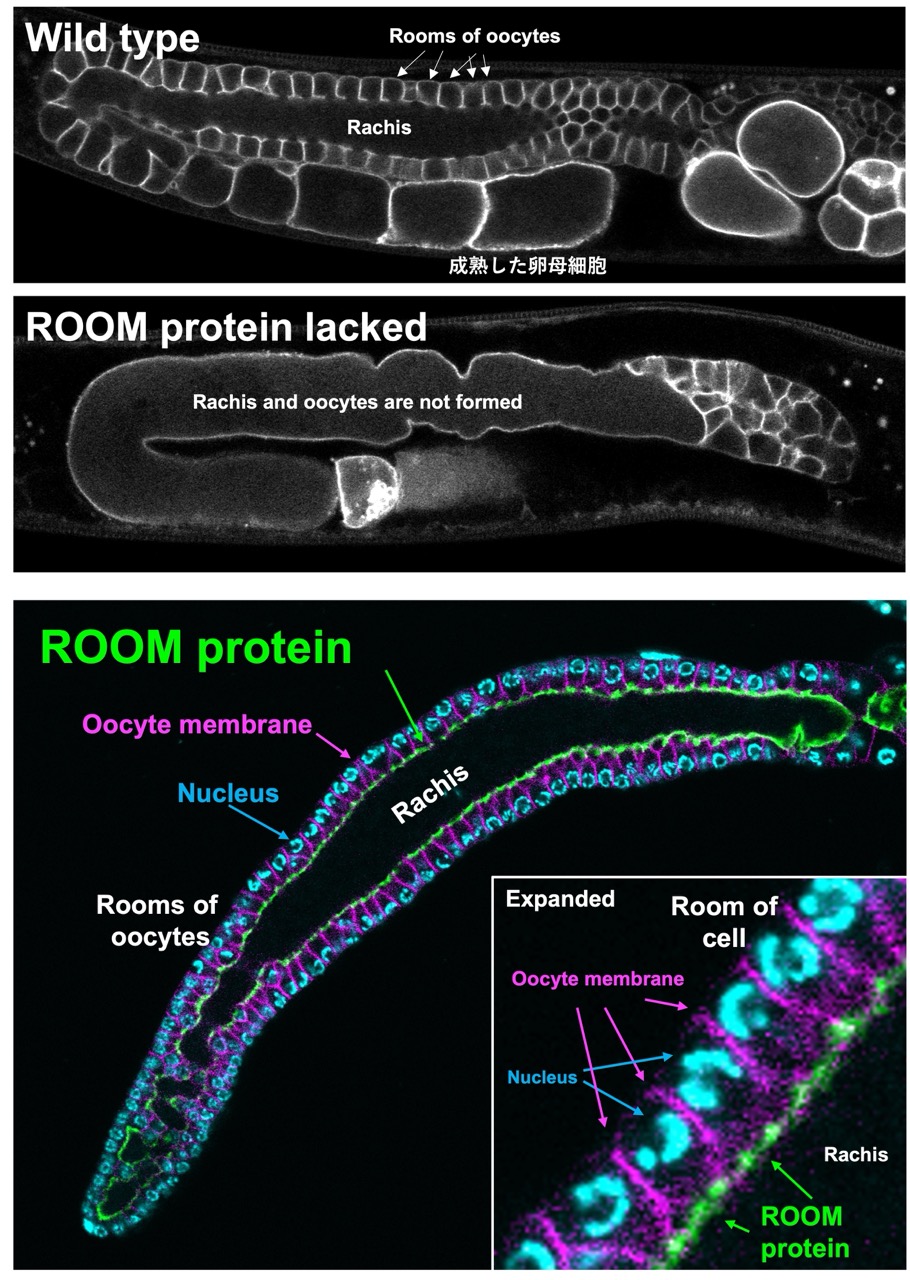
The formation of oocytes (eggs) is an essential step in many animals. As oocytes mature, they undergo repeated incomplete cell division from a single cell, resulting in a state where multiple cells share components (known as a syncytium). While it is known in many organisms that actomyosin and proteins playing auxiliary roles are involved in the formation and maintenance of syncytium, many aspects of this process remained unclear. We have now discovered that when the ROOM-1 and ROOM-2 proteins are lacked in the nematode Caenorhabditis elegans, oocytes fail to form entirely, and the organism becomes unable to produce offspring. Detailed observations revealed that oocyte formation does not proceed because cellular compartments fail to form properly during the process of syngamy (Figure). Since ROOM proteins have a structure that anchors directly to the cell membrane, this suggests that ROOM proteins anchor to the boundary of the oocyte to fix actomyosin, thereby maintaining incomplete cell division.
Paper information
Sugiura K, Kawasaki I, Kosako H, Sato K. Transmembrane ROOM proteins ensure rooms for germ cells by maintaining intercellular bridge. PNAS, 2026 123 (19) e2522264123
Online URL
https://doi.org/10.1073/pnas.2522264123